
Copyright Protection for Content Creators in the Digital Age
Introduction
The advent of the internet and digital platforms has revolutionised the way that creative content is created, shared and consumed. The rise of social media platforms, streaming services, blogs, podcasts, and AI tools has paved the way for creators to connect with audiences like never before. At the same time, however, it has also led creatives to be vulnerable to mass infringement of copyright, illegal duplication, and economic exploitation. In contrast to the traditional era, where the copying of creative works was restricted by the physical process of reproduction, in the digital era, copying and dissemination can occur in seconds and can happen worldwide.
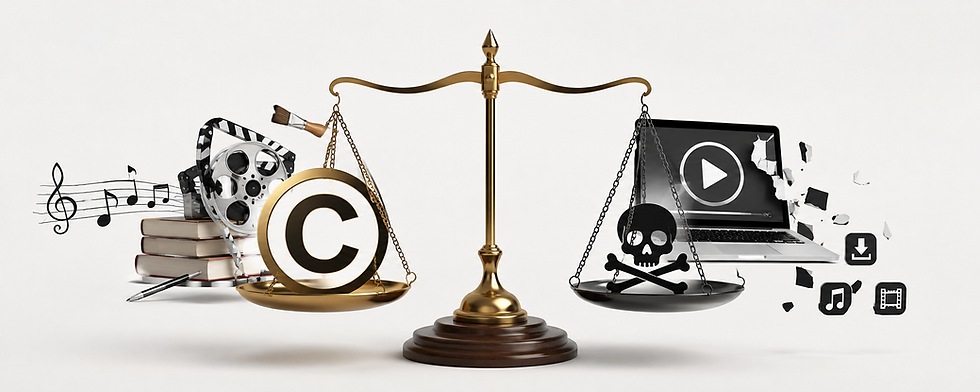
These days, most content creators, whether it's writers, musicians, filmmakers, educators, influencers, or anyone else you can think of, depend on digital spaces to monetise and gain visibility. However, they have also played a role in pirating, the reposting of copyrighted material without authorisation, and the manipulation of copyrighted content using algorithms. Thus, today, copyright law must serve to reconcile three competing interests:
protection of creators’ rights,
promotion of innovation and creativity, and
preservation of public access to information.
In this article, the authors examine some of the most prominent challenges to copyright posed by “content creators” today, and assess the effectiveness of current copyright laws to safeguard creators in an increasingly technologically advanced society. This article explores the copyright issues that content creators encounter today, reviews the status of copyright law, and proposes changes needed to serve content creators in a technologically-driven world better.
Evolution of Copyright Protection in the Digital Era
The copyright function was originally conceived to prevent the copying of books, movies, and music. With the advent of digital technology, however, the nature of infringement has changed radically, with low cost, real-time reproduction and borderless availability.
The international organisations responded to these technological advances by creating new legal measures to modernise copyright protection. The World Intellectual Property Organisation Copyright Treaty (1996) set standards for technology protection measures and digital copyright protection. Likewise, the TRIPS agreement of the World Trade Organisation has enhanced the IP rights of member countries.
The Copyright Act 1957 was amended in India in 2012 with regard to digital issues, such as digital rights management systems and rights of performers. While these changes have been implemented, enforcement has proven to be a problem because of the evolution of technology and the fact that infringement can be committed online with no regard for borders.
Major Challenges Faced by Content Creators
Digital Piracy and Unauthorised Distribution
One of the biggest challenges in the online world is digital piracy. Once a film is released, it's quickly uploaded onto illegal sites and torrents in just a few hours. As soon as a movie is released, it's being uploaded to illegal sites and torrents within just a few hours. As per the reports released by the OECD, online piracy is grossly impacting creative industries by cutting down the revenue streams and thereby diminishing the incentive to create original content.
This is especially a challenge for independent artists who don't have the institutional funding that big media houses do. The creative community is regularly targeted for the redistribution of paid educational content, e-books and quality digital courses via cloud-sharing and messaging services without their permission. Moreover, the internet is a very anonymous medium, making enforcement virtually impossible. Identical copies can still be found on mirror sites and on other domain names even after the original site has been removed. Therefore, the traditional copyright enforcement mechanisms are often found to be ineffective and inefficient in combating the speed and scale of digital piracy.
Ambiguity Surrounding Fair Use and Transformative Content
There is also an emerging “remix culture” in the digital age, with users making memes, reaction videos, commentaries, parodies and edited compilations of existing copyrighted material. This has led to complicated legal issues about the level of infringement that such use involves. Section 52 of the Copyright Act allows for limited “fair dealing” exceptions to the copyright infringement rules for certain purposes, including criticism, review, reporting of current events, and other purposes. But the Indian law does not offer much judicial guidance on transformative digital content, as compared to the wide-ranging “fair use” doctrine of the U.S. Copyright Act.
Clips from movies or songs are often used to illustrate reaction videos or commentary channels, along with criticism/analysis. The distinction between transformative content can get murky in court. This means creators and users are exposed to the uncertainty of the law when using the internet. Moreover, the automated copyright enforcement mechanisms adopted by digital platforms often delete content without considering complex legal issues. This may result in excessive censorship and suppression of legitimate creative expression.
Intermediary Liability and Platform Accountability
Digital platforms like YouTube, Instagram, and Facebook are mostly platforms that act as intermediaries for the publication of user-generated content. One of the most controversial questions in copyright law is whether such platforms are liable for infringing the copyright of the content that users upload. The “safe harbour” principle, in which intermediaries are deemed to be protected if they remove infringing content once they've received notification, is recognised in most jurisdictions. The Information Technology Rules, 2021, are applicable to intermediary obligations, in part, in India.
But critics say that big tech profits from copyrighted content without being held accountable. YouTube's Content ID system and other automated tools have enhanced copyright detection, but have also raised privacy concerns around potential abuse and misuse by large corporations. Smaller creators may not have the financial and legal leverage to fight back against wrongful claims. In a few cases, the courts in India have also ruled on intermediary liability. The Delhi High Court has considered the role of online intermediaries in preventing copyright violations in the case of Super Cassettes Industries Ltd v MySpace Inc. The case raised the issue of the growing conflict between platform immunity and the enforcement of copyright in the digital space.
Artificial Intelligence and Emerging Copyright Concerns
Artificial intelligence has emerged as perhaps the most significant contemporary challenge to copyright law. Generative AI systems are trained on massive datasets containing text, images, music, and videos, many of which may be copyrighted works.
Does AI training amount to copyright infringement?
Should creators be compensated when their works are used for machine learning?
Can AI-generated content receive copyright protection?
Who owns AI-generated creative outputs?
Many artists and writers are worried about how AI systems are copying their work without permission or payment. AI systems are copying the work of many artists and writers without their permission or payment, and many are concerned about this. Current copyright laws are mostly unfit for the world of machine-made creativity. This has led to a need for copyright laws that are specific to AI technology and can strike a balance between innovation and the protection of the economic rights of the creator.
Need for Legal and Policy Reforms
To effectively protect content creators in the digital age, copyright law must evolve alongside technological developments. Several reforms are necessary.
Stronger Enforcement Mechanisms
The digital intermediaries must take greater responsibility for repeated infringement on their platforms. Meanwhile, there should be measures in place to avoid arbitrary censorship and the abuse of automated takedown tools.
Greater Platform Accountability
Digital intermediaries should bear increased responsibility for repeated infringement occurring on their platforms. At the same time, safeguards must exist to prevent arbitrary censorship and misuse of automated takedown systems.
AI-Specific Copyright Regulations
Legislatures must formulate clear legal standards regarding:
use of copyrighted works for AI training,
ownership of AI-generated content,
licensing requirements,
compensation frameworks for creators.
Increased Legal Awareness Among Creators
It is unfortunate that many independent creators are not aware of the procedures for copyright registration, licensing agreements and contractual rights. Enabling creators to better protect their work in digital environments through legal literacy programs and institutional support.
Conclusion
The digital age has transformed creativity, made it available to all audiences and opened up new ways of expressing creativity. However, there has also been an increased risk of copyright infringement, digital piracy, platform exploitation and legal uncertainty. While some of these copyright systems can be modified to partially accommodate technological developments, they still fall short of meeting the new challenges, especially in terms of intermediary liability and artificial intelligence.
Thus, it is crucial to have a balanced and reform-oriented copyright regime. This should safeguard the economic and moral rights of creators while also ensuring the preservation of innovation, transformative creativity and freedom of expression. Copyright has become a cultural, economic and legal imperative to preserve the modern creative ecosystem.
Author: ABHISHEK GOPE , in case of any queries please contact/write back to us via email to chhavi@khuranaandkhurana.com or at Khurana & Khurana, Advocates and IP Attorney.


Comments