
Online Copyright Enforcement in India: Statutes, Cases, and Remedies
I. Introduction
The digital ecosystem of India has grown rapidly to create new methods for producing and sharing protected works but this development has also increased the likelihood of copyright violations which occur through online platforms. Online piracy currently operates through multiple channels which include unauthorized streaming services and torrent downloads and mirror websites and illicit digital uploads and these channels are becoming more advanced. Creation of digital content and production of films and operation of online businesses require enforcement as their fundamental requirement.
The Copyright Act of 1957 together with the Information Technology framework and the Jan Vishwas Act 2023 and Cinematograph Amendment Act 2023 established an Indian legal system that contains multiple methods for law enforcement which are currently developing. Courts have developed new protective methods through their creation of innovative remedies which include dynamic and Dynamic+ injunctions that enable rights-holders to fight against both current infringing websites and upcoming mirror websites. The article assesses the existing copyright enforcement system in India through its examination of statutory laws and important court decisions and available copyright enforcement methods while showing how creators can protect their work in the fast-evolving digital environment.
II. Legal Framework and Recent Amendments
The Copyright Act of 1957 in India protects all forms of creative expression which include literary works and musical compositions and artistic creations and films and other artistic expressions.[1] The author holds exclusive rights to reproduce and distribute and perform the work according to Section 55 which allows them to request either an injunction or damages.[1] The law used to make infringement a criminal offense which carried a maximum penalty of three years imprisonment according to Section 63.[1] The Jan Vishwas Amendment Act 2023 serves as a major update because it decriminalized normal infringement cases by replacing imprisonment penalties with higher fines that apply to first-time offenders.[2] The legal system conducts most cases as civil matters while it uses criminal charges only for intentional piracy that involves extensive operation.
The Cinematograph Act of 1952 serves as another vital law because it targets the illegal distribution of films. India's government enacted the Cinematograph Amendment Act in 2023 to improve enforcement measures. The law provides explicit authorization for police officers to perform their duties according to the IT Act when they handle cases of unauthorized film recording and it gives them authority to arrest people who distribute unlicensed movie material through intermediary platforms.[3] The amendment establishes tough penalties for film piracy which include a maximum prison sentence of three years and financial penalties that reach up to five percent of production expenses[4].
India follows international intellectual property treaties which include the Berne Convention. The law defines online piracy as a violation that rights holders can use to initiate civil or criminal cases against infringers. Intermediaries which include platforms and ISPs only receive safe harbor protection when they do not know about ongoing infringement activities. The platform must delete the content after receiving proper notice to keep its immunity. The Information Technology Intermediary Guidelines Rules require large platforms to create grievance departments while they need to eliminate illegal content without delay. Rights holders need to use both copyright notices and IT no- to protect their intellectual property rights.
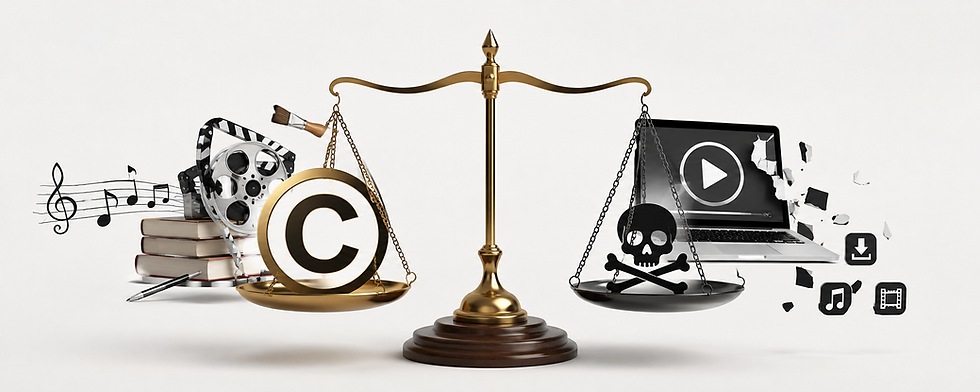
![[Image Sources: Shutterstock]](https://static.wixstatic.com/media/3f05e9_d123a118abc14ce0996c1eb5108baaa2~mv2.png/v1/fill/w_648,h_439,al_c,q_85,enc_avif,quality_auto/3f05e9_d123a118abc14ce0996c1eb5108baaa2~mv2.png)
III. Landmark Case Law on Online Piracy
Indian courts have quickly tackled digital piracy with new doctrines:
MySpace Inc. v. Super Cassettes (Delhi HC, 2014): The court ruled that uploading an unauthorized musical track to the web constitutes copyright infringement because infringement occurs when someone illegally shares music online. The court determined that the Internet qualifies as a "place" which Section 51 protects. MySpace (the platform) was held liable because it had been notified of the infringement – even without a court order – suggesting that platforms must act once they have knowledge. The court established that online distribution of copyrighted material constitutes copyright infringement under the Act while indicating that platforms lose their safe harbor protection after receiving copyright infringement notifications..
UTV v. 1337X.to (Delhi HC, 2019): Often cited as India’s first dynamic injunction case. UTV brought legal action against identified torrent websites while seeking to block access to all secret mirror websites. The court reached a decision according to which blocking one website fails because copycat websites emerge. The court permitted UTV to introduce mirror domains through CPC Order 1 Rule 10 which classified them as new ways to reach identical content. The system allowed automatic extension of the injunction to newly established piracy websites which required no additional legal proceedings.
The DDA v. Hariyali case about live streaming and the NEXGTv v. PVR Cinemas case about event streams demonstrate that Indian courts consider online activities as infringing when essential rights are violated. The piracy enforcement system has experienced major changes because of dynamic blocking doctrines which control all online content.
IV. Platform Policies and Intermediary Guidelines
Online platforms (YouTube, social media, etc.) implement copyright takedowns, but Indian law adds special rules:
Copyright Rules 2013 (Notice-and-Takedown): The Copyright Rules from 2013 establishes the Notice-and-Takedown system which requires rights holders to send a takedown notice that includes their commitment to sue the intermediary. The intermediary must block the designated content within 36 hours after receiving the notice and maintain this blockage for 21 days. The plaintiff maintains blocked content until the court proceeding for their injunction is finished. The content will be restored after 21 days if the plaintiff fails to obtain a court order[14]. Intermediaries receive protection from this Indian-specific scheme when they conduct temporary hosting activities and respond to received notices. YouTube must remove the video you reported after you provided complete notice because it will take them 36 hours to remove it until you start your legal proceedings.
Section 52 Safe Harbors: The law establishes exceptions through Section 52 Safe Harbors. The law permits fair dealing for three purposes which include reporting news and supporting educational activities and making critical assessments[15]. Section 52(1)(b) and (c) explicitly shield temporary or incidental copies (like streaming cache)[16]. The existence of buffering creates an automatic system which allows users to track music through its momentary playback without creating any copyright issues because the entire process occurs in real time without permanent record creation. The protections enable ISPs and platforms to function without encountering liability issues from their technical duplication activities.
Platform DMCA-Style Policies: The major worldwide platforms operate their current systems in India according to their established DMCA policies. Indian rightsholders can access YouTube's three strikes system and content ID while Facebook and Instagram offer IP infringement forms. Platforms tend to respond to inquiries about their operational rules by using a standard response which states that they follow all relevant laws[17]. Rights-holders report that U.S.-style takedowns (via Content ID or DMCA notices) are typically how removals happen. The Indian legal system allows you to use those mechanisms while it requires you to follow the Rule 75 process to receive legal protection as an intermediary.
Platform tools and formal notice procedures work better together for a rights-holder's needs. When an infringing video is found, you need to submit a Rule-75 notice to make the intermediary accountable for their actions while you must inform the platform's copyright team about the issue. You must prepare for legal action if the content remains accessible after your attempts to remove it.
V. Enforcement Steps for Rights-Holders
Document Everything. The infringing material must be documented through screenshots and downloads which must have their date and URL details recorded. Copyright Office registration of your work is essential to establish strong claims for your films and software projects.
Cease-and-Desist Notice. The infringer or hosting party must receive a written notice that demands content removal. The Supreme Court in Midas Hygiene v. Bhatia declared cease-and-desist orders to be "a very significant and valuable tool" which courts use to obtain injunctions. Your notice should name both parties, describe the copyrighted work, detail the infringement, and state your demands. The deadline must be established as 21 days according to Rule 75, which also states that legal action will be taken if the deadline is not met. The process initiates through this action which establishes good faith between both parties at the same time.
Platform Takedown Notice. The website or application needs to use its copyright complaint system for users to report copyright violations. You must provide details which include both a specific description of the copyrighted material and the infringing website link along with your ownership declaration. The platform receives legal notice through your reference to the Copyright Act and/or Section 52. The platform must take immediate action after receiving the report through disabling the content and notifying the uploader according to standard procedures[13].
File a Lawsuit. The plaintiff must first file a lawsuit which provides evidence that the defendant continues to commit copyright infringement throughout various locations. The plaintiff must pursue their case through either the Commercial Court or the High Court or the dedicated intellectual property court. The plaintiff must seek both injunctive relief and financial compensation. The plaintiff can identify unknown defendants who committed the infringement by using the names John Doe and Ashok Kumar. The plaintiff must provide proof of their ownership rights and the defendant's notification. The plaintiff should request an emergency interim injunction which would immediately restrict access to the material. Rights holders now regularly request court orders to mandate ISPs for domain blocking while registrars must suspend domain registration services. You should include an affidavit that contains screenshots and notice letters and user complaint logs to support your argument.
VI. Dynamic Injunctions and Blocking Orders
The Indian judiciary system now employs dynamic injunctions to address new torrent websites instead of bringing separate lawsuits against each new website. The system allows administrators to block all cloned websites which share the same operators after the first site receives an injunction[7]. Rights-holders present new URLs to the court registry whom they want to add to the injunction which the registrar will execute immediately.
The Dynamic+ injunction which operates through Dotmovies serves as the system's main breakthrough. The system automatically extends its coverage to all subsequent uploads. The original injunction protects all new websites which Warner Bros used Dynamic+ to establish after the company released its new film because they unveiled the content through new sites[9]. Courts follow established procedures to instruct domain registrars about which domains to suspend and which telecom authorities to use for domain blocking.
ISPs receive separate legal authority which enables them to block specific domains entirely. The 2017 Madras case (Ashok Kumar v. YouTube) required ISPs to block piracy websites although the order went beyond necessary restrictions[20]. The Department of Telecom informs ISPs about court blocking orders which typically form part of dynamic injunctions in order to implement national access limitations when courts issue these orders.
Rights-holders can use these tools to terminate entire pirate networks through more efficient methods. Indian courts demonstrate how they handle internet cases through their judicial system because online protection measures evolve with technological progress.[9][7]
VII. Preventive Practices and Technical Tools
Beyond legal action, creators can adopt measures to deter piracy:
Digital Watermarking/Fingerprinting: Creators can use different strategies to protect their work from piracy. The first method uses digital watermarking and fingerprinting which creates invisible watermarks and distinct fingerprints for every copy of a particular file. The system enables you to track stolen material back to its original source through its ability to endure modifications. The system uses fingerprinting algorithms to conduct large-scale online content searches which can identify matches using YouTube Content ID as one of its examples. The system uses this method to identify unauthorized content usage during the initial stage of detection..
Automated Monitoring: The system employs automated monitoring through web crawlers and AI tools which monitor internet activity. The services operate continuously to index websites and social media platforms while they notify users when their material becomes available[22]. The system generates takedown alerts through automatic processes. The system enables bots to issue DMCA notices which identify all streaming site and file-hosting platform matches. The system facilitates quick detection of copyright violators who can then be caught at an early stage..
Metadata and Licensing Tags: The system requires you to provide all digital files with identification metadata which includes ID3 tags for audio and EXIF data for images and copyright declarations. Your website must display specific usage guidelines for users to follow. The system creates a non-technical obstacle which establishes your ownership rights while informing users about content protection measures.
The implementation of these steps decreases infringement risk although prevention methods cannot achieve complete protection. The combination of early threat detection with watermarking and DRM protection creates obstacles which reduce damage effects thus decreasing the number of court disputes which need resolution[18][23]. Your legal approach needs to operate together with your technical security measures according to this principle.
VIII. Conclusion
Online piracy in India creates significant problems yet legal authorities are beginning to address this issue. The government has declared its zero tolerance policy toward digital movie piracy through the Cinematograph Amendment and Jan Vishwas Act[4][2]. Courts use dynamic injunctions and domain blocks as new tools to combat piracy[9][7]. Major platforms comply with takedown notices under these laws which provide rights-holders effective methods to eliminate infringing content.
Rights-holders need to stay active by collecting evidence of any violations they encounter while using the statutory notice-and-takedown process[13] to obtain injunctions whenever necessary. The organization needs to implement technical protection methods which include watermarking and monitoring and secure distribution systems to protect against unauthorized use. Copyright holders in India can safeguard their copyrighted materials through robust legal action and preemptive strategies which operate in the fast-paced online environment[9][23].
Author: Riya Sharma, in case of any queries please contact/write back to us via email to chhavi@khuranaandkhurana.com or at Khurana & Khurana, Advocates and IP Attorney.
Sources: The sources include Indian Copyright Act (1957) Cinematograph (Amendment) Act (2023) Jan Vishwas Act (2023) and IT Act and rules plus landmark cases and legal commentary[1][4][5][9][12].
Footnotes
[2] The Impact Of The Jan Vishwas Act, 2023: Patents, Trademarks & Copyrights - Trademark - India
[8] Analysing “Dynamic+” Injunctions: Delhi High Court’s Latest Judicial Invention – SpicyIP

FEMA Compliance is important for businesses involved in foreign investments, remittances, and cross-border transactions.
It helps companies follow the rules related to foreign exchange and international financial activities.
Proper FEMA compliance can reduce the risk of penalties and regulatory issues.
Businesses should maintain accurate records and complete applicable FEMA reporting on time.
Professional guidance can help ensure smooth and timely FEMA Compliance.
This is a helpful explanation of WOS Compliance and its importance for wholly owned subsidiaries operating in India. Understanding the applicable Companies Act requirements, reporting obligations, and timely filings can help businesses maintain proper compliance. Compliance Calendar LLP provides professional guidance for WOS Compliance, including documentation and filing support. A useful resource for businesses looking to manage their compliance requirements efficiently.
The discussion on dynamic injunctions in cases like UTV v. 1337X. to highlights a crucial evolution in copyright enforcement in India. It's fascinating how the courts are adapting to the digital landscape by allowing rights holders to block not just known infringing sites but also their mirror counterparts. As someone who follows digital content trends, I see this as an important step to protect creators in an age where online piracy can rapidly evolve. It’s encouraging to see legal frameworks keeping pace with technology.
Ensuring product quality and safety is essential for building consumer trust, and ISI Certification plays a major role in maintaining these standards in India. Businesses seeking compliance can benefit from understanding the certification process, required documents, and approval guidelines through ISI Certification. It is a valuable step toward legal compliance and market credibility.