
Who Owns What? The IP Rights That Arise from Employee-Created Artificial Intelligence Workflows
Introduction
Using A.I. tools as part of the employees' day-to-day functions have significantly changed how employees develop/create, draft/design, & deliver their work product(s). We see this change through junior associates directly using ChatGpt to create legal memos; engineers directly using GitHub Copilot to write code; and marketing professionals directly using A.I. image generators to create visual images for marketing campaigns. Henceforth, between using A.I. tools today, A.I. becomes an operational reality, no longer a futuristic novelty, throughout all industries.
This newly developed operational reality now leads to a legally significant and mostly unresolved issue; when an employee uses an A.I. tool to create a product in the course and scope of employment, who owns the resulting intellectual property? The employer is paying the salary and providing the infrastructure? The employee is directing the A.I. and using their skill and judgement to improve the output? Or the A.I. tool manufacturer does the model which ultimately generates the basis of all the content?
Historical legal frameworks for intellectual property creation have been based upon the concept of human authorship and inventorship that goes back to the beginning of time. In India, this general premise has not been adequately addressed in the Copyright Act, 1957 and the Patents Act, 1970. Although certain aspects have been addressed in the Doctrine of Work-for-Hire and the Doctrine of Employment, there are many gaps in the law. Many other countries, including the United States, the United Kingdom and the European Union similarly are struggling with these same issues. The purpose of this blog is to provide an overview of the existing legal framework, discuss the legal challenges presented by AI-generated works, evaluate the impact of employment contracts and company policies, identify the case law surrounding this area of law, and assess the potential impact on employers, employees and policymakers.
Legal Provisions
A. Copyright Act, 1957
The Copyright Act of 1957, as amended in 1994, states that under Section 2(d)(vi), in the case of computer-generated works, the 'author' would be defined as 'the person who causes the work to be created'. This is one of the few statutory provisions relating to computer-generated works within Indian legislation, even though the provision is not specifically geared towards situations involving AI-assisted employment.
According to Section 17, the initial ownership of the copyright is vested in the author. However, a proviso within Section 17 holds that in the event of a work created by an author being created in the course of employment under a contract of service or apprenticeship, the employer shall be considered the first owner of the copyright in the absence of any contrary agreement.
B. The Patents Act, 1970
Section 6 of the Patents Act, 1970 allows a patent application to be filed by the true and first inventor or their assignee. This section or any other part of the Act does not make any reference to the issue of AI inventorship. Where there is technical inventive input from an AI system, who is to be considered the ‘true and first inventor’ is a very controversial issue. In cases of employment, issues regarding patents are sorted out using the provisions of the assignment agreement.
C. Trade Secrets and Confidential Information
There is no separate legislation governing trade secrets in India. Confidential information, which would include AI-created data, is protected under contract law, the principles of breach of confidence, and certain parts of the Information Technology Act, 2000.
D. International Context
The TRIPS Agreement mandates that member countries must provide protection to computer programs by treating them as literary works within the meaning of the Berne Convention, which in turn assumes authorship by humans. The UK Copyright, Designs and Patents Act, 1988 (CDPA), in Section 9(3), provides that the author of a computer-generated work is “the person by whom the arrangements necessary for the creation of the work are undertaken.” This is the most advanced provision in an international statute addressing this issue. In the U.S., the Copyright and USPTO have always taken the view that copyright and patents can only be granted to works of human authorship and inventors, respectively.
Legal Analysis
A. Question of Authorship
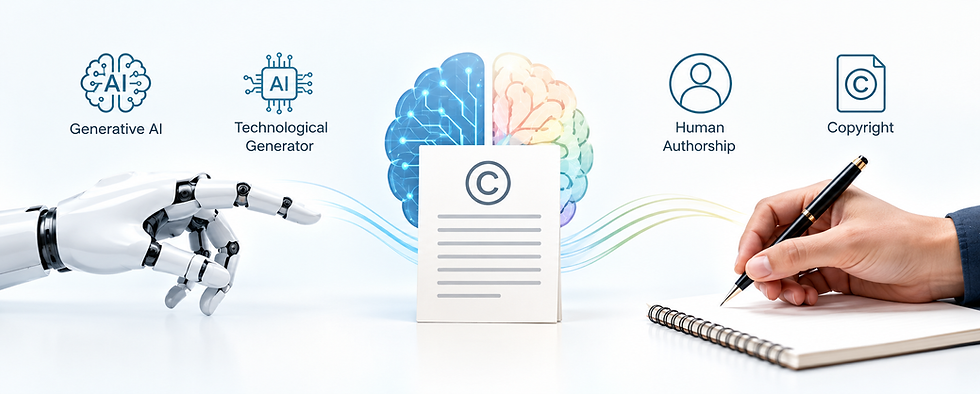
Authorship in the existing IP legislation is assumed to be the result of human creativity, skill, and originality. In a case where an employee utilizes an AI tool for creation of output, creative input is made by at least three people: the employer (who supplies the tool and assigns its purposes), the employee (who directs the AI tool, creates prompts, and shapes the output based on the judgement) and the provider of the AI tool (who provides the tool that creates the output).
According to Section 2(d)(vi) the ‘person who causes the work to be created’ in the case of a computer generated work can be considered to be the employee who operates the AI tool. This needs to be supplemented by the provisions of Section 17 in terms of the employer proviso: if an AI assisted output is created in the course of employment as per contract of services, the employer becomes the first copyright owner. There is a key difference between AI assisted works (which are created using substantial human input) and AI generated works (which are autonomously created by the AI tool with minimum human intervention)
B. The ‘Course of Employment’ Test for Employment
Whether something qualifies as being done in the course of employment has been analyzed based on the following factors: (i) whether the creation of the product was done within the scope of the employment contract; (ii) whether the time and materials of the employer have been utilized; and (iii) whether the product has been created as part of the usual activities of the employee. In respect of an AI-based workflow, an employee using an AI tool that has been licensed by the employer on company time to deliver a product to a client will easily satisfy all three elements.
C. Employment Agreements and IP Assignment
The Copyright Act, Section 17 is subject to any contrary agreement. Employment agreements, IP assignment agreements, and non-disclosure agreements are thus the chief means by which the statutory position can be varied. A well-drafted employment agreement would contain a comprehensive IP assignment clause for all works created using company resources, an IP assignment clause relating to the use of AI-tools, and a carve-out clause for inventions made outside employment.
Old-style employment agreements that were made without considering the use of AI-tool technology often lack provisions regarding AI-tool outputs. Overly broad IP assignment clauses that seek to assign to the employer all works that an employee may create at any point may violate general contract laws, although the Indian Courts have been very generous with commercial contracts between skilled parties.
D. AI Tool Provider Assertions
AI tool providers usually mention intellectual property ownership issues in their terms of use. OpenAI, for example, disclaims ownership of any outputs produced and assigns those outputs to the users according to the laws. But the allocation of rights made by the contract between the user and the provider does not solve the question of ownership dispute between the employer and the employee, especially where an employee uses his personal AI tool account.
E. Patent Inventorship in AI-Inspired Innovation
A patent demands that a real and original inventor be identified — meaning a human inventor who conceived of the invention — to fulfill legal requirements. In cases where AI provides contribution that would be considered inventive in human circumstances, the existing statutory scheme cannot encompass AI as an inventor, and the human who controls the AI may not satisfy the inventive step criteria. There is a contradiction in that technologically innovative AI-informed output may be ineligible for patent protection because there is no one who can claim inventorship, but may also qualify as trade secret and/or employer copyright material.
Case Laws
Indian Cases
In Eastern Book Company v. D.B. Modak [(2008) 1 SCC 1], the Supreme Court of India has laid down that there needs to be a minimum level of creativity in the work for copyright protection. For applying this principle in AI-generated works, one may have to consider whether the act of using the AI tool by an employee meets the threshold of creativity or whether the level of creativity lies with the AI itself.
In Rupendra Kashyap v. Jiwan Publishing House [1996 (38) DRJ 81], the Delhi High Court, while dealing with computer-generated question papers, ruled that the institution for which the work had been generated was capable of claiming copyright protection as per the phrase “causes the work to be created” in Section 2(d)(vi).
International Cases
In Thaler v. Vidal (43 F.4th 1207, Fed. Cir. 2022), the U.S. Court of Appeals for the Federal Circuit affirmed the USPTO’s denial of patents with AI systems listed as the inventors, as the requirement of the Patent Act mandates that an inventor must be a person. This is highly relevant in determining any legal issues arising between employers and employees, where AI systems are responsible for inventions – neither the employer nor the employee can claim being the inventor of such invention, which may be patent ineligible.
In Thaler v. Perlmutter (D.D.C. 2023), the US District Court ruled against registering the copyright on an image created solely using an AI system, finding that copyrightable works require human authorship.
In Acohs Pty Ltd v Ucorp Pty Ltd [2012] FCAFC 16, the Australian Federal Court ruled that copyright could not exist for computer-generated works that do not have a human creator. Although it was decided before the emergence of generative artificial intelligence, this case is useful to demonstrate how courts consider the requirement of human creativity.
Practical Considerations
1. Employer Considerations
Employers need to determine whether existing IP assignments and employment agreements have adequate coverage regarding AI-generated content. Most contracts prior to 2020 do not mention the use of AI tools. It would be wise for employers to adopt an AI use policy which will state the use of certain tools in the workplace, the requirement of the use of company licensed accounts, and that any output generated through the use of AI tools in the workplace is considered work product of the employer. Innovation-based companies need to determine if there are enough contributions from humans in order for patentability.
2. For Employees
It is important for employees to recognize the IP ramifications associated with the use of AI tools. Work created by using a personal subscription to an AI tool during one’s personal time might not fall under the intellectual property claims of an employer based on the specificities of the employment contract. Employees who make a substantial contribution to the creation of content through the use of AI tools in terms of prompting and editing may have more of an argument regarding personal ownership of the work.
3. Policy Disputes and Future Trends
The World Intellectual Property Organization (WIPO) has interacted with AI and IP to a great extent through its WIPO Conversation on IP and AI initiative. However, no guidance has been published by the Indian Copyright Office and the Office of the Controller General of Patents, Designs and Trade Marks in regard to the use of AI-generated works; nonetheless, the National IPR Policy, 2016, stresses the need for modernization of IP systems. There is an increasing amount of literature in support of creating a special sui generis form of intellectual property right for AI-generated works that recognizes there is no human author but at the same time encourages investments in such creations.
Conclusion
The issue of who owns IP in AI processes created by employees falls within the realm of labour law, intellectual property law, contract law, and technology law. Three major conclusions can be drawn from this analysis. Firstly, the employer is most probably the initial owner of copyright in works created with AI assistance during the employment period, except if otherwise agreed to, assuming that the works qualify for copyright protection. Secondly, works that are wholly created using AI assistance without any sufficient input from human creators do not qualify for copyright protection under the existing legal regime. Thirdly, patent inventorship can only be attributed to natural persons.
The following steps need to be taken:
Modification of the provisions of the Copyright Act, 1957 concerning authorship in the context of AI-assisted works and AI-created works based on Section 9(3) of the UK CDPA.
Issuance of official guidelines by the Indian Copyright Office and CGPDTM regarding the treatment of AI-created works and AI-assisted inventions during examination.
Issuing standardized clauses for the use of AI and IP ownership rights for employment contracts after consultations among various stakeholders.
The introduction of a sui generis regime for the protection of full AI-created works, which should be aimed at encouraging investment in AI-based innovation while retaining the human authorship criterion in traditional copyright laws.
In the absence of any legislation, employers and employees should consider including explicit terms of AI-generated IP ownership in employment contracts, setting up an AI usage policy and consulting experts in AI-based IP and technology law.
Author: Shreya Sharma, in case of any queries please contact/write back to us via email to chhavi@khuranaandkhurana.com or at Khurana & Khurana, Advocates and IP Attorney.
Endnotes
The Copyright Act, 1957 (Act No. 14 of 1957), ss. 2(d)(vi) & 17, Government of India, available at: https://www.indiacode.nic.in.
Eastern Book Company v. D.B. Modak, (2008) 1 SCC 1; Rupendra Kashyap v. Jiwan Publishing House Pvt. Ltd., 1996 (38) DRJ 81 (Delhi High Court).
Thaler v. Vidal, 43 F.4th 1207 (Fed. Cir. 2022); Thaler v. Perlmutter, 687 F. Supp. 3d 140 (D.D.C. 2023).
World Intellectual Property Organization (WIPO), Revised Issues Paper on Intellectual Property Policy and Artificial Intelligence (WIPO Conversation on IP and AI), WIPO/IP/AI/2/GE/20/1 Rev., 2020, available at: https://www.wipo.int/about-ip/en/artificial_intelligence/.
OpenAI, Terms of Use (Output Ownership provisions), available at: https://openai.com/policies/terms-of-use; see also UK Copyright, Designs and Patents Act 1988, s. 9(3), available at: https://www.legislation.gov.uk/ukpga/1988/48/contents.

Comments