
From Waste to Worth: EPR’s Role in the Textile Industry
Updated: Jun 16
What is EPR?
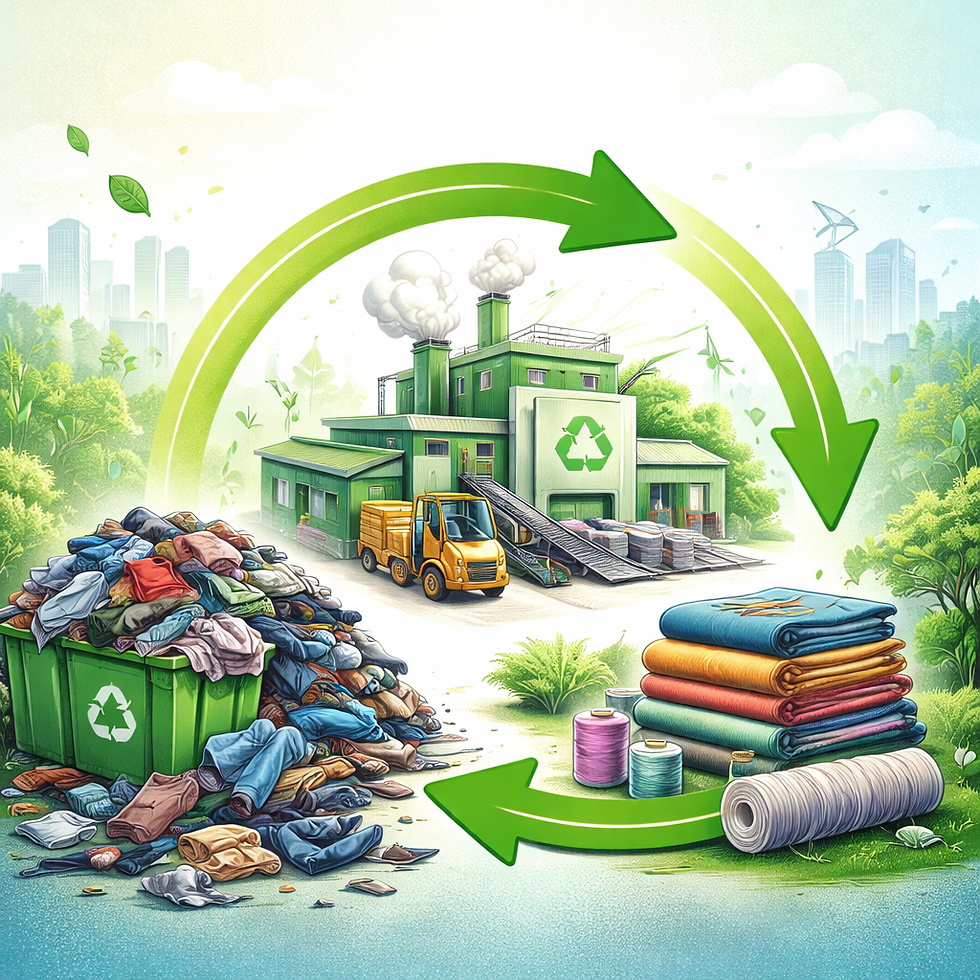
Extended Producer Responsibility (EPR) holds producers responsible for the whole lifecycle of their products, including disposal and recycling. It is a crucial step in preserving the environment and properly disposing of waste. EPR policies were developed in response to the need to address increasing waste and inefficiency in traditional disposal systems. They aim to create a circular economy, in which materials are reused and recycled rather than destroyed. India, like many other countries, is making rapid progress in terms of environmental sustainability. Compliance with Extended Producer Responsibility (EPR) is an important part of this journey. An EPR policy holds producers responsible for controlling post-consumer waste and the entire lifecycle of their products.
EPR has been more popular in India in recent years, and the government has enacted a number of laws and policies to support it. With the introduction of the National Environmental Policy (NEP) in 2006, EPR was first implemented in India in the early 2000s. The Solid Waste Management Rules, 2016, were also announced by the Ministry on April 8, 2016. Producers must comply with these rules in order to manage their trash and recycle their goods.
Until now, India has mostly used EPR for batteries, e-waste, and packaging. As a symptom of a larger shift toward sustainable waste management, several nations are starting to expand EPR frameworks to industries like textiles. Need for EPR in the Indian Textile Sector
In India approximately 45 million people are employed by textile and apparel sector, which is enormous in terms of job creation. But a developing problem that gets much less attention is that the business produces over 7,800 kilotonnes of waste annually. The majority of this waste ends up in landfills intermingled with regular waste.
Following plastics, the textile sector is the third-largest source of dry municipal solid waste, according to a recent analysis from the Center for Study of Science, Technology, and Policy (CSTEP). Presently, only 34% of India's textile waste is recycled into yarns. The fact that the rest of the garbage is either landfilled, downcycled, or burned indicates that the problem cannot be adequately addressed at scale by the waste management techniques currently in use. EPR aims to improve textile and garment waste collection and management, leading to a sustainable circular economy .
This approach has been adopted by numerous countries, who have tailored Extended Producer Responsibility (EPR) frameworks to suit their particular national interests and infrastructure.
Inspiring Role Models
France
The first nation to use EPR as a tool for textile management policy was France. Refashion, France's only textile PRO(Producer Responsibility Organisation), manages the country's EPR program for textiles, which has been in force since 2007 and covers apparel, footwear, and home linens. The plan would provide households with credit for repairing their products. The credit is applied directly to families as a discount on authorised firms' invoices for repairs.
The order demands that Refashion create reports on textile recyclability and durability, as well as propose eco-modulation with recyclability as a criterion. Goals include collecting 60% of production weight by 2028 and recycling or reusing 70% of collected material by 2024 and 80% by 2027. France outperforms the EU average of collection and collection volume is growing. The scheme has achieved relatively high rates of re-use and recovery of collected and sorted material (60%), significantly outperforming the European average reuse rate (8%) of collected post-consumer textiles.
EU-Wide Harmonisation Efforts
In February 2025, a provisional agreement on the planned reform of the Waste Framework Directive was achieved to promote circularity and sustainability in the sector, as well as to slow the growth of fast fashion. This set standardized guidelines on the EPR plan for textile businesses and fashion labels, forcing them to pay a charge to help fund trash collection and treatment, based on how circular and sustainable their product design is. EPR adheres to the "polluter pays principle," which places the entire net expense of managing textile waste on one member of the supply chain (often, the importer into the EU or brand owner).
In a recent development, the European Parliament adopted its final position on March 13, 2024. On EPR, the Parliament agrees with the European Commission's proposal to introduce the plan. The purpose is to sort used textiles for reuse, while non-reusable textiles are prioritized for recycling.
NETHERLANDS
The Netherlands aspires to create a circular economy by 2050. As part of the Dutch circular economy strategy for textiles, EPR legislation was adopted in July 2023, with required targets for producers in place by 2025. Beginning in 2026, producers will be required to report on these targets. The Dutch EPR system includes apparel, workwear, and home textiles including tablecloths, bed linen, and towels. It does not cover footwear, purses, blankets, or curtains. Customers should be able to dispose of their old textiles for free.
Textile manufacturers must allow consumers to dispose of their old textiles at any time and at no cost.. By 2025, companies must achieve a minimum of 50% textile recycling and 20% reuse, with targets rising to 75% recycling and 25% reuse by 2030.
Way Forward For India
1.Sector specific recycling goals
For the sector to effectively implement EPR, as France did by establishing a central target based system, clear and customised recycling targets for various materials should be set. This will ensure that recycling efforts are in line with the unique needs and capabilities of each material category.
2.National and regional targets for collection, reuse and various bodies to keep a
check
Due to diversity in India, it becomes very pertinent to establish state, regional bodies that deal with the target specified for various organs , enterprises ,producers etc of the textile industry.
3.Technology and Infrastructure
It is crucial to make targeted investments to close infrastructural gaps.It should be easier for industry and research institutes to work together to promote technological developments that enhance waste management and recycling procedures.
4.Phased Deployment Strategy
As demonstrated by the Netherlands, prioritising consumer accessibility through the development of free take-back systems and concentrating on a phased deployment strategy, first concentrating on high-impact categories (e.g., clothes, workwear, household linens).
5. Information and openness
The adoption of EPR is made more difficult by a lack of formalisation, which results in gaps in data and accountability. The effectiveness of EPR standards depends on improving data collection and transparency across the value chain. Creating strong reporting and monitoring systems will aid in tracking textile waste and guaranteeing responsibility.
6.Unambiguous legislative policy
Drawing inspiration from the EU's polluter pays model, a primary focus might be on establishing a clear legislative framework that assigns producer responsibility and financial duties.
7.Active Participation from key participants/stakeholders
Finally, to properly adopt EPR, it is imperative that all important supply chain players actively participate. Adopting sustainable practices and having a common knowledge of roles and duties are essential for compliance. The textile industry may move towards a circular economy with the help of clear regulatory frameworks, robust enforcement tools, increased consumer demand for recycled goods, and capacity-building and awareness initiatives.
India may adjust its EPR strategy in light of these lessons acquired to address the unique challenges faced by the textile and apparel sector. The industry will move closer to implementing more sustainable and circular processes as a result of formulating EPR guidelines.
Conclusion
An important part of the textiles strategy should be EPR. By making producers pay for end-of-life expenses rather than communities and citizens, this method puts the polluter pays principle into practice.
Since the main issue with textiles is overconsumption, it is imperative that, at the at least, EPR cover all end-of-life costs and factor them into the price that customers pay. To define the aims, classifications, criteria, standards, and reporting requirements, more study is required, including in-depth stakeholder consultation. Without effective leadership, Member States run the risk of adopting disparate strategies that will raise producer costs while falling short of delivering the advantages that could be obtained by adopting a unified strategy and utilizing the internal market's ability to promote favorable environmental change.
Author: Shreya Thakur and Astha Sinha, in case of any queries please contact/write back to us via email to chhavi@khuranaandkhurana.com or at Khurana & Khurana, Advocates and IP Attorney.


Comments