
Digital Fair Use and the Plight of Content Creators: The Need to Amend the Copyright Act, 1957 for Transformative Works in the Social Media Era
Introduction : YouTube was the main platform for content creation in India before the COVID-19 blackout. However, the extended quarantine period caused widespread boredom among some segments of the populace, which led many to embrace content creation on new social media platforms like Instagram and TikTok, turning what had previously been a recreational activity into a feasible part-time or full-time career.
The Copyright Act of 1957 must be immediately amended to protect the rights and interests of creators, or a comprehensive new law must be introduced to address the particular difficulties of the digital content ecosystem, since at least 10% of India's population now actively works as content creators.
The definition of content creation is nowhere mentioned accurately (legally) but the Cambridge University has defined content creators as the activity or job of creating content (= video, images, writing, etc.) for the internet, especially for a social media website as a way of promoting a brand or product or gaining followers.
What is evolving in Content Creation?
Content creation will become a distinctly technology, trust-driven, and target-oriented field starting in 2026. As platforms progressively prioritise and reward individuals who regularly provide genuine content, the era of haphazard, uncontrolled publishing will no longer yield significant returns.
Adopting AI-driven content discovery, learning platform-specific content strategies, moving to community-first engagement, and implementing information-based content planning are all crucial changes that creators must do in order to thrive in this new era.
Ultimately, those who treat content creation as a professional business rather than a casual pastime will be the ones who thrive and flourish in the years ahead.
Issues with copyrights of the content creators with respect to AI
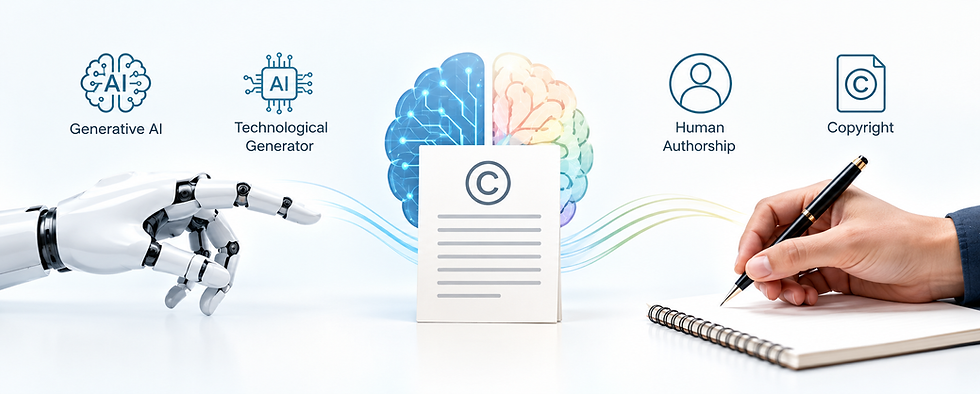
Artificial intelligence is not yet recognised as an author under Indian copyright law. Ownership rights remain to belong only to human creators in the absence of explicit legal instruction. However, a limited window for recognising significant human oversight in the creation of AI-assisted content is opened by some interpretations of Section 2(d)(vi), especially the wording "the person who causes the work to be created." The twin pillars of uniqueness and human creativity continue to be the key requirements for preservation in the absence of legislative reform.
Indian courts have always held that originality necessitates a "modicum of creativity." As a result, works created using only mechanical or automated procedures have not been protected.According to this reasoning, content produced solely or mostly by AI would most likely not meet the originality requirement. Thus, even as more general policy discussions about reform start to take shape, India maintains a strong human-centered approach to copyright.
How can the works of content creators be secured?
It has been stated that AI can create art. Well, that is not true. In fact, AI is actively destroying art. The efforts and dedication which the creators put into making unique art goes unrecognized and waste because the same can be created by AI these days. The flaws and the ideas of the creators itself make art, an art. But the perfection with which AI does the same, people are bound to cherish it more and most of the time the difference between human-made art and the AI-created art cannot be distinguished. But that is the reality of today’s content creation.
Fundamental concerns regarding the validity and significance of moral rights in the context of AI-generated content are raised by the attribution of such rights to AI, which lacks the capacity for subjective or emotional experience. The existing legal system, which was designed to safeguard human dignity and reputation, is not appropriate for non-human creatures that lack these qualities. Additional ethical and legal difficulties are raised by the question of responsibility and culpability for content produced by AI. A natural person can be held responsible for producing and distributing content, according to the conventional legal system. However, as AI is not a human, it cannot be punished by the law or held accountable for content that can be offensive, libellous, or otherwise damaging. This raises serious questions regarding the possible abuse of AI in content creation and the suitability of current legal remedies to deal with such problems.
What is the way forward?
There have been more and more requests to modify the Indian Copyright Act to take these technical developments into account in light of the complexity surrounding AI-generated works. One suggestion is to classify AI as a tool rather than an author, guaranteeing that a natural or legal person is the owner of works produced by AI. Such legislative modifications will adjust the legal framework to the reality of technology progress while offering much-needed accountability and transparency.
With initiatives like the "AI for All" campaign and the creation of the AI Task Force, which focuses on using AI for social and economic development, the Indian government has taken aggressive steps to realise the potential of AI. However, the lack of a thorough legal framework that effectively handles the particular difficulties brought up by AI-generated content undermines these efforts. In 2021, the Parliamentary Standing Committee Report called for a comprehensive overhaul of intellectual property rights laws, recognising the increasing importance of AI in a variety of industries and its potential economic consequences. Citing research from Accenture that suggests AI-related developments will significantly boost the Indian economy by 2035, the report highlights the need to build a strong IPR framework in order to "extract benefits from AI." Although the report offers a broad strategic perspective, it does not include specific challenges or specific solutions for AI and intellectual property that may be put into practice.
Secondly, in order to properly reflect the reality of the AI era, where algorithms may produce derivative or transformative works, the fair use concept needs to be broadened and improved. To ensure a balanced approach that upholds the rights of original artists while promoting technological innovation, clear and specific standards are required to define what constitutes fair use of existing copyrighted material by AI.
Thirdly, it is critical to protect the interests of small artists and innovators. The legislation ought to include provisions that allow these people to prevent their creations from being used in AI training datasets without their express permission. To guarantee that artists maintain control over their intellectual property, this may entail enforcing stricter consent standards and requiring AI companies to be more transparent about the data they use.
Author: Anika Tarar in case of any queries please contact/write back to us via email to content@khuranaandkhurana.com or at Khurana & Khurana, Advocates and IP Attorney.
Endnotes
The Copyright Act, 1957, No. 14 of 1957, ss. 2(d)(vi), 13, 14, 17, 51, 52 and 57 (India). Section 2(d)(vi) identifies, in relation to a computer-generated literary, dramatic, musical or artistic work, the author as the person who causes the work to be created. Sections 13 and 14 govern copyright subsistence and exclusive rights, Section 52 contains statutory exceptions, and Section 57 protects authors' special or moral rights. The statutory framework does not expressly recognise an artificial intelligence system itself as an author.
Eastern Book Company & Ors. v. D.B. Modak & Anr., (2008) 1 SCC 1; Civil Appeal Nos. 6472 and 6905 of 2004, decided on 12 December 2007 (Supreme Court of India). The Supreme Court considered the standard of originality under Indian copyright law and held that copyright requires more than merely mechanical labour, recognising the importance of skill, judgment and a minimal degree of creativity. The decision remains central to analysing whether human intellectual contribution is sufficient for copyright protection.
Department-related Parliamentary Standing Committee on Commerce, 161st Report, Review of the Intellectual Property Rights Regime in India, Rajya Sabha Secretariat (2021). The Committee examined the implications of emerging technologies, including artificial intelligence, for India's intellectual-property framework and recommended greater policy attention to the challenges and opportunities created by AI and technological development.
World Intellectual Property Organization, WIPO Conversation on Intellectual Property and Artificial Intelligence, Issues Paper on Intellectual Property Policy and Artificial Intelligence. WIPO has identified authorship and ownership of AI-assisted and AI-generated works, copyright protection, liability, and the use of protected material in AI systems as major unresolved questions requiring continued policy consideration.
The Copyright Act, 1957, s. 52 (India). India's copyright framework principally uses specific statutory exceptions and limitations—commonly described as “fair dealing” in particular contexts—rather than a general open-ended “fair use” doctrine equivalent to that found in some other jurisdictions. Any proposed protection for transformative digital works would therefore require careful legislative drafting or interpretation within the existing statutory framework.
World Intellectual Property Organization, Revised Issues Paper on Intellectual Property Policy and Artificial Intelligence, WIPO Conversation on Intellectual Property and Artificial Intelligence. The international policy debate addresses, among other issues, whether and under what circumstances copyright-protected works may be used for machine learning, how transparency regarding training data should operate, and how the interests of creators, right holders, technology developers and the public should be balanced.

Comments