
Deity Names Being Trademarked: Navigating Through Section 9(2)(B) and Judicial Inconsistencies
Introduction
Religion is at the heart of Indian life. It sets the tone for values, dictates cultural norms, and moulds public opinion. In recent years, religion has also made its way into business, as brand owners in increasing numbers tap the names of gods and goddesses, spiritual icons, holy texts, temples, and saints to peddle products and services. Such names possess a native emotional connect, making the offerings more relatable and trusted by consumers. The emergence of religious branding raises pressing issues of exclusivity and faith, of monopolization and legal oversight within trademark law.
The Indian law considers that the religious identity is not a mere intellectual property. Under section 9(2)(b) of the Trade Marks Act a trade mark shall not be registered if it contains anything which may hurt religious feelings of any class or section of citizens of India. Although this provision is designed to safeguard collective religious feelings, it is subject to broad interpretation that empowers courts discretion, and it has led to a number of contradictory verdicts. This blog evaluates the law pertaining to the registration of deity names as trademarks with a special focus on section 9(2)(b), relevant judgements, and considerations as to why more clarity is warranted
Commercialisation of Religious Elements
he emotional and cultural significance that is attached to the names of divinities often makes them attractive commercially. Marks like “Ganesh,” “Krishna,” “Lakshmi,” “Ram” are commonly seen across sectors for this very reason. These types of marks also have a perception of purity and trust that can captivate a consumer's attention immediately.
The purpose of trademarks is to protect a single business from others using identical marks. When a trademark covers a religious word, it means no one can use it (or a similar one) to identify their faith or buy a product representing their faith. Religious items like symbols belong to everyone and every person has a legal right (Constitutional) to practice their faith by using these symbols. Private ownership of divine symbols creates a tension between commerce and an individual's Constitutional Rights to be free to express religious views under Article 25 of the Constitution.
An example of this principle can be seen in a recent ruling by the Supreme Court regarding a trademark dispute involving two businesses, Ganesh Grains Ltd. and Shree Ganesh Besan Mill[i]. The Supreme Court ruled that no party may claim exclusive rights to the name of a divine being. The appellant claimed they were the original user of the trademark "GANESH." However, the Supreme Court agreed with the Calcutta High Court, which found that "Ganesh" is widely used within commerce and represents an important deity across numerous cultures. The Supreme Court ruled against granting a business monopoly on the name "Ganesh," stating such an exclusive right would violate the public good and the common religious beliefs surrounding the deity. The ruling of the Supreme Court supports the view that names associated with religion should remain open to public access for all those who wish to honour them, as they are important expressions of culture and spirituality for large groups of people.
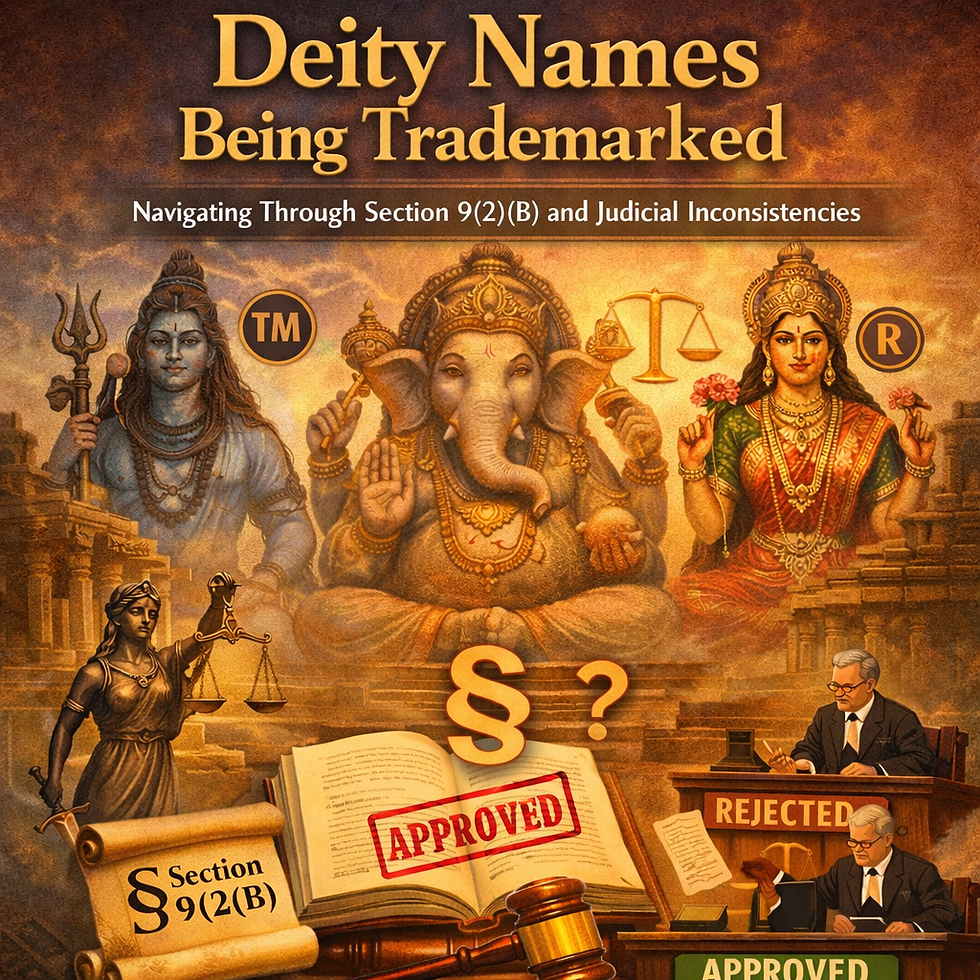
Understanding Section 9(2)(B)
Section 9(2)(b) is one of the Absolute Ground for Refusal of trademark registration. It states “(2) A mark shall not be registered as a trade mark if: (b) it contains or comprises of any matter likely to hurt the religious susceptibilities of any class or section of the citizens of India.” [ii] According to this section, if a trademark's content can be interpreted as being able to harm someone's religious sentiments, the applicant will be unable to register a trademark. The intent behind utilizing a trademark is important; however, the public perception is of greater importance than the intent behind using a word or image on a product.
There are no guidelines given in this section to properly assess the level of religion that may affect an individual's ability to register a trademark. This section may create confusion in India with so many religions and thousands of symbols affiliated with them and determining what is considered offensive in marketing is a complicated matter. Hence, here judicial discretion plays the major factor for placing into practice this Section where certain court interpretation of this section will vary from one court to another within the same state and between courts in different states.
Judicial Ambiguity: Competing Rulings
A prominent example of inconsistency can be seen in how the courts treated the terms "Ganesha" and "Ramayana." In Mangalore Ganesh Beedi Works v. Union of India [iii], the Court permitted the registration of "Ganesha" for use in connection with beedis and thus rejected the claim of “as beedis are smoked (a practice that is viewed as sinful within Hinduism) and the packaging is disposed of, will create a negative impact on individuals' sense of religious sentiment.”
The Supreme Court in Lal Babu Priyadarshi v. Amritpal Singh, (2015) [iv] denied registration of the mark "Ramayana" to market incense sticks, finding that granting a monopoly over a sacred religious document was contrary to the public good and the historical and spiritual heritage of countless people. The Court's ruling stated, "No single individual can have a monopoly over religious scriptures".
The decisions demonstrate that the judgments made under Section 9(2)(b) of the Act are based primarily on how a Court perceives the application and not by specific criteria set out in the Act. The inconsistent nature of the Court's application of Section 9(2)(b) complicates the process for applicants, trademark offices, and courts themselves.
Considerations Distinctiveness and Public Domain Considerations
One of the challenges encountered by religious names is Section 9(1)(a) of the Trade Marks Act, 1999, where "distinctiveness" is required. Deity names are often found in a variety of contexts and industries. Such names indicate a belief rather than identifying an individual business. A trademark serves to create an association between the buyer and the seller of products and services. If a name does not create an association, it cannot be protected under trademark law. Consequently, many religious names may not meet requirements for exclusive protection because they do not describe any one particular business but it the name belongs to all.
In Bhole Baba Milk Food Industries Ltd. v. Parul Food Specialities Pvt. Ltd.[v] the High Court of Delhi made it very plain that, in establishing an exclusive right to use a trademark, you must show that the mark has been used for a sufficient period of time and is sufficiently associated with your products/services as to create goodwill. In this instance, the appellant argued that, because of the years of use and increasing sales of their products that have the name KRISHNA associated with them, the word KRISHNA has come to be so strongly associated with the appellant's products, that the word has become an indicator of the appellant's products. The Court found, however, that because Lord Krishna is associated in Hinduism with milks, ghee, and butter, the name KRISHNA is indeed a common term within the dairy industry, and that many other milk producers use the name KRISHNA. The Court concluded that because the name KRISHNA is commonly used by many producers of dairy products, the appellant can claim no exclusive right to it, especially since the name KRISHNA is directly related to the nature of the products.
The Court permitted the Respondent's use of the phrase "PARUL'S LORD KRISHNA" but required that all three components be shown as equals and not placed in such a way as to give prominence to only the word "KRISHNA". Because of this requirement, consumers would identify the product with the entire brand name rather than only connected to the Deity. Establishing distinctiveness or secondary meaning for religious names is very difficult and this case illustrates that difficulty. So many millions of people have a common spiritual connection with these names that they cannot be relied upon to serve as unique commercial designations. Therefore, religious names are available for public use and exclusive trademark protection is very rarely awarded.
Trademark Ownership: Religious Groups and Temples
When temples or religious organisations attempt to secure trademarks for the names or images of their deities, many modern issues arise. Recently, an example of this occurred when the Attukal Bhagavathy Temple[vi] Trust received a trademark for the image of the deity and the phrase "Sabarimala of Women" from the High Court of Kerala. Understanding that the Trust represented and managed the best interests of the deity, the High Court accepted the request from Temple Trust.
Moreover, giving exclusive control of a God’s name or image to one temple creates a potential problem. The exclusivity of the temple could eliminate the use of that sacred identity by other devotees or groups that subscribe to that same religion. Thus, religion could be viewed as a commodity, contradicting the notion that all believers in faith should be considered equal.
Global Perspective and India's Middle Ground
Various nations have different interpretations of how religious trademarks should be treated according to trademark law. For example, in Singapore and the U.K., it is very straightforward that, if a trademark can cause harm to religious beliefs or appear to demean a person's faith, then it will be disallowed. Trademark offices within those countries take an extensive look at these types of applications to ensure that no use is made of sacred names or symbols that may damage public sentiment or be contrary to the morals of the citizens in that country.
In many ways, the United States and China represent a much more flexible regime when it comes to registering religiously based trademarks. Many times, these two countries will allow trademarks that consist of a religious name or symbol, so long as the entity registering the trademark does not intend to deceive consumers or mislead the public.[vii]
The viewpoint of India is not as one extreme (protection entity characteristic of one's glory) or the other (punisher of all who deny the protection of others), but more of a midpoint, or perhaps an 'honourable compromise' as it is referred to, between both schools of thought (the punishment aspect). The law itself is very broad and does not provide any explicit, concrete examples of what constitutes valid protection of religious feelings, nor what are the acceptable, agreed upon methods for protective mechanisms or appropriate penalties. Accordingly, therefore, court decisions can vary substantially based solely on individual factual situations presented in each instance before the respective court, which leads to court decisions that may differ widely, even in very similar situations.
Brand owners do not know for sure if their trademarks will be registered or not and in addition the law has failed to consistently offer the public a protection of their feelings. India will continue to seek a constant balance between the freedom to operate a business and the need to respect religion.
The Need for Standardised Guidelines
As sections 9(2)(b) now stand, there are several interpretations possible; therefore, the confusion surrounding this section is quite high. A clear definition is needed regarding "hurting religious sentiments" along with providing a concrete basis for courts and assigned trademark personnel to evaluate if a mark violates or impinges upon an individual's religious sentiment. Due to these inconsistencies, there has been no reliable or standardised way to predict outcomes in trademark disputes.
India needs to establish a more precise methodology to differentiate between trademarks which genuinely damage religious values versus trademarks which merely reference religious values without being offensive. As such, trademarks, like other facets of intellectual property, require greater clarity in order to promote fair and thoughtful consideration of the underlying issues associated with them.
Conclusion
The rise of trademarks being used with a prominently depicted religious name is an indication of the growing overlap between faith and business. Using a religious name could enhance the connection between consumers and the brand; however, allowing companies exclusive rights to a name creates both practical and cultural issues. Most names associated with a deity and all sacred symbols have a common significance to millions and converting those names and symbols into private property is likely to create disputes and create confusion among consumers. Section 9(2)(b) was drafted in an attempt to mitigate these issues; however, this lack of well-defined guidelines has resulted in inconsistent decisions and uncertainty for trademark applicants.
The growing number of cases reported in India which relate directly to the use of religious symbols makes it evident that a more systematic and consistent process is necessary. By establishing clearer threshold standards, authorities can determine when religious symbols are acceptable and when this use crosses into inappropriate or exclusive use, by having more definitive guidelines. In this way, India can achieve a healthy balance between branding for commercial purposes and protecting religious sentiments while ensuring all people can use religious names and symbols without the risk of inappropriate ownership or monopolisation by one person or business.
Author: Shreya Lal, in case of any queries please contact/write back to us via email to chhavi@khuranaandkhurana.com or at Khurana & Khurana, Advocates and IP Attorney.
[i] Ganesh Grains Ltd. v. Shree Ganesh Besan Mill, 2022 SCC OnLine SC 2280.
[ii] Trade Marks Act, 1999, § 9(2)(b) (India).
[iii] Mangalore Ganesh Beedi Works v. Union of India, A.I.R. 1974 S.C. 1832 (India).
[iv] Lal Babu Priyadarshi v. Amritpal Singh, (2015) 16 S.C.C. 795 (India).
[v] Bhole Baba Milk Food Indus. Ltd. v. Parul Food Specialities Pvt. Ltd., 2011 (48) P.T.C. 235 (Del.).
[vi] Petition Against Trademark on Temple Dismissed, NEW INDIAN EXPRESS, Sept. 13, 2013.
[vii] E-Journal of Academic Innovation & Research in Intellectual Property Assets (E-JAIRIPA), Vol. II(I), Jan.–June 2021, at 45–58.


Comments