
Copyright Rhetoric in the Age of AI
Introduction : A prominent debate among the legal circles today is the recognition of AI-authorship and copyright infringements, especially in the context of artworks. The use of ChatGPT to create Ghibli-style images has fueled these concerns, with many people questioning the legal and ethical consequences. The intersection of AI and copyright policies and the corresponding ownership titles helps us reflect on the fundamental roots of the present legislative framework and the actual objectives intended. This blog will focus on the AI–Ghibli style image generation, the surrounding debates on copyright violations and the recognition of AI-ownership, along with some new policy formulations and case laws.
The Complex Scenario of Studio Ghibli and Copyright Legislative Framework
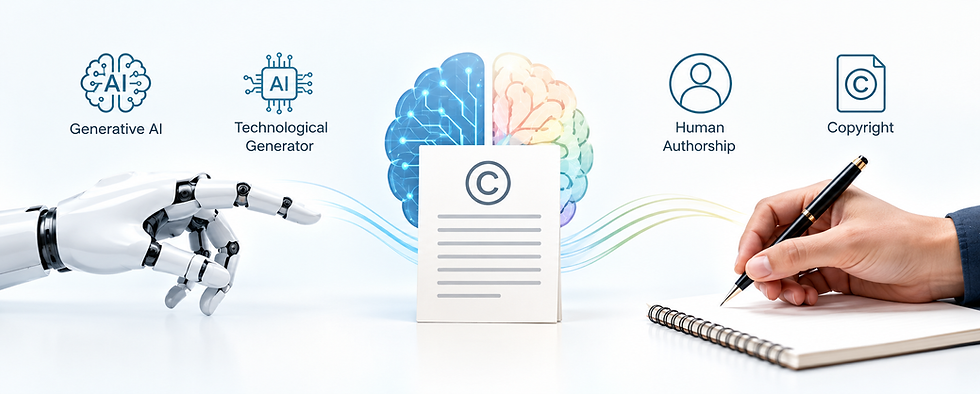
Copyright is an intellectual property protection granted to people over their work, by means through which they can control the reproduction, distribution, adaptation and display of their work. Under the existing global copyright standards, such protection is offered only for original creations by a human author. The main purpose is to recognise and value the creativity and the cognitive and intellectual aspects of the innovation, which is the fundamental distinguishing factor, making it unique and worthy of being protected.
This essentially means that only a particular work or adaptation of an author will be protected and not the style, composition or the strokes used. This is the exact legal complication in the case of Ghibli-style images. Studio Ghibli is known for its unique styles incorporating strong nature patterns and soft colour tones, with more artistic, yet creative exploration of the character's emotions, differentiating it from other creators. Studio Ghibli has copyrighted its animated works.
The use of the Ghibli style, in a strict legal sense, does not attract infringement, unless the generated images predominantly represent a character or a frame from this copyrighted content.
A whole trail of arguments focuses on the ethical and moral rights, where mimicking the style essentially weakens the heart and soul of the work. As quoted from Hayao Miyazaki, the founder of Studio Ghibli, every work displays enormous amounts of emotions and creative cognition and holds immense value, which is diluted with the AI-based generations.
Also, some critics argue that to generate a similar style of images, OpenAI had to train its model on large datasets of Studio Ghibli works, which might also include access to protected works and processing them without requisite authorisation, amounting to infringement. Some might argue the fair use policy, but cases such as the Authors Guild v. Google, Inc. (2015) restricts such use only for transformative public purposes. Cases such as NYT v Open AI & Ors., address concerns on unauthorised use of copyrighted materials and prioritise the ownership rights.
In India, Sec 52 of the Copyright Act covers the doctrine of fair use in cases of innovations serving public interest and importance. In Civic Chandran v. C. Ammini Amma (1996), the Kerala High Court laid down a four-factor test to identify and limit the fair use, which stipulates that the purpose, nature of use, the amount of use and the impact on the market value of the work have to be considered to determine the same.
This brings us to a crucial point of understanding AI authorship and the multi-dimensional challenges associated, given the existing legal framework.
AI Authorship or Ownership in Existing Legal Framework of Intellectual Property Rights
In Thaler v. Perlmutter and in Commissioner of Patents v. ThalerAI authorship was not recognised to grant the patent. However, the increasing use of AI by multiple creators have prompted some form of classification in the USA. According to the US Copyright Office Report, 2025, the AI-generated works have been distinguished based on the degree of AI integration and human contribution. Works, with minimum human input, such as a normal prompt to generate a work, are not considered for patent and are deemed to be insufficient. Substantial human creativity is necessary, where a creator might generate components of his work, but re-edits, arranges and uses it in a unique manner, reflecting his intellectual originality. In such cases, only the selection or the arrangement of such components is copyrightable and not the individual components. Examples include A collection of objects which do not exist, Zarya of the Dawn and A single piece of American Cheese.
AI-assisted music codes have also been granted protection in the same categories. Collaborative creations between AI and humans are recognised for dual authorship, where the creator makes a major contribution, in arranging and digitally compositing the elements into a larger work, with multiple layers and details, with AI being used more as a tool or software to generate, integrating it into a broader aspect. Such works are recognised as copyrightable.
AI generation brings in many crucial challenges and questions in the context of innovation, which is evolving with contemporary times. The questions raised have to be addressed to bridge the legislative and policy gaps. Not copyrighting the AI components might lead to further problems, where such elements can be replicated and reused when available to third parties in the public domain. These scenarios create additional loopholes, complicating the situation.
Indian Laws are similar to the Berne Convention, where protection is granted to original works of humans. In the landmark case of Eastern Books Co.& ors v D B Modak, the court held that sufficient modicum of creativity is necessary to extend copyright. In Navigators Logistics Ltd. v. Kashif Qureshi & OrsThe High Court ruled that a compilation lacking human authorship does not qualify for copyright protection. However, some recent cases have deviated from this conventional viewpoint. RAGHAV, an AI tool, rejected at first instance, was subsequently allowed after its owner, Ankit Sahni, was listed as the co-owner. Another software named Suryast has also been approved, giving direction for a newer interpretational change and the evolving perspectives of legal principles.
The EU, through its copyright provisions in the Digital Single Market (DSM) Directive and the recently adopted AI Act, has taken a more prescriptive approach, creating text and data mining (TDM) exceptions while simultaneously requiring AI developers to respect copyright opt-outs and maintain transparency regarding their training data. Japan and Singapore have introduced bespoke exceptions that permit computational data analysis without explicit permission from the rights holder. Conversely, several jurisdictions maintain closed lists of exceptions that either prohibit or severely limit the use of machine learning applications on copyrighted material. China has approved protection for an AI-generated image through an Internet court ruling. However, the regulations mandate that the work demonstrate human intellectual effort and originality, making it novel. Such works have to be clearly labelled as AI-generated, and in cases of misinformation, the companies will be held liable.
Conclusion
To conclude, as technology continues to evolve, legal frameworks have to be updated as well. New standards for training and permissions have to be enabled for monitoring copyright violations. Authorship has to be extended, both theoretically and practically, to acknowledge the use of AI and focus on the newer types of AI-integrated human originality, which will serve as the new determinant of innovation. More legislation should be developed on the use of Generative AI and regulating its implications, not just in IPR, but in other fields and divisions as well, which are simultaneously growing and developing. Sui generis rights for AI-generated content are also a newer solution. Disclosure mechanisms have to be strengthened, and stakeholder discussions have to be promoted, to engage in meaningful collective action. Clarity and consistency are necessary to ensure a hassle-free and adaptable enforcement of the policies. Inter-governmental collaborative efforts are also encouraged in this regard, to promote decisiveness, transparency and predictability and balance both the legal and the ethical aspects.
On an end note, as legal reform proceeds, there should be an ideal equilibrium that safeguards the legitimate interests of both artists and innovators, preserving artistic integrity while embracing the opportunities of generated artistry.
Author: Sravanthi Nambirajan in case of any queries please contact/write back to us via email to content@khuranaandkhurana.com or at Khurana & Khurana, Advocates and IP Attorney.
Endnotes
Copyright Act, 1957, §§ 13, 17, 52 (India). Section 13 sets out the classes of works in which copyright subsists; Section 17 addresses the first ownership of copyright; and Section 52 provides statutory exceptions to infringement, including specified instances of fair dealing.
Eastern Book Company & Ors. v. D.B. Modak & Anr., (2008) 1 SCC 1 (Supreme Court of India). The Supreme Court adopted a “modicum of creativity” approach to originality, requiring more than purely mechanical skill or labour for copyright protection.
Thaler v. Perlmutter, 687 F. Supp. 3d 140 (D.D.C. 2023), aff’d, 127 F.4th 1276 (D.C. Cir. 2025). The U.S. courts rejected copyright registration for a work claimed to have been created solely by an AI system, reinforcing the requirement of human authorship under U.S. copyright law. The U.S. Copyright Office's 2025 AI report further explains that AI-assisted works may qualify where sufficient human expressive contribution is present, whereas prompts alone generally do not establish authorship.
U.S. Copyright Office, Copyright and Artificial Intelligence, Part 2: Copyrightability (Jan. 2025). The Report concludes that existing copyright principles can address AI-generated outputs and that copyright may subsist in human-authored expressive elements, including sufficiently creative human selection, arrangement or modification of AI-generated material, but not in purely AI-generated material lacking sufficient human control.
Regulation (EU) 2024/1689 (Artificial Intelligence Act), Recitals 105–107; Directive (EU) 2019/790 on Copyright and Related Rights in the Digital Single Market, Art. 4. The EU framework addresses copyright compliance in the training of general-purpose AI models, including policies concerning copyright and rights reservations for text and data mining, together with transparency obligations concerning training-content summaries.

FNAF 3 takes the series beyond the familiar pizzeria and into Fazbear's Fright, an attraction built from old Freddy Fazbear legends. The unusual location, forgotten memorabilia, and mysterious atmosphere create a fresh setting for fans to discover.