
Artificial Intelligence and Copyright : Who owns AI-Generated Content?
Introduction
AI is a heavily debated subject in the current tech. landscape. The capability of a machine to execute tasks that necessitate human intelligence is referred to as AI. John McCarthy stated that “Artificial Intelligence is the engineering and science of creating intelligent machines, particularly intelligent software programs”. Artificial intelligence is mainly created to replicate the ability to think and solve problems like humans. AI has rapidly developed, causing complex issues that are clashing with the legal system. Nevertheless, the question of copyright ownership for AI generated content remains complex, as it involves determining whether the creator is the programmer, the AI itself or the user inputting its prompts, all these have sparked an ongoing legal and ethical debate.
AI is essential in fostering creativity and innovation, and it is closely connected to intellectual property law. This link brings up questions regarding how intellectual property rules ought to consider AI’s involvement in producing creative content. The issues required knowing how to strike a balance between rewarding innovation and safeguarding existing copyright rules. Nowadays, AI is generating human-like contents like, writing poetry, composing music and many other contents which humans build through their emotions to connect to people, is it really fair to have these done by a machine which does not have any emotions. Is it fair for human talent to be replaced by a machine?
What is Copyright?
Copyright is nothing but a legal protection over the original expression of an idea, innovation or creation that gives a legal control to the creator, so that no creation can be mimicked or copied. In India the copyright law is governed by the Copyright Act, 1957.According to the Act credits are given to the original owner which creates a fair competition in the market and protects the authors from being exploited. Not all the original works will get copyright protection, under section - 13 of the Copyright Act, 1957 explain the different types of works that are eligible for copyright protection like literary works (books, articles etc.), dramatic works (play), artistic works(paintings, art works) cinematography etc. any work that is copyrighted the original owner will be given certain rights explained under section 14 of the act like protection from copying, sharing it publicly and translating it into another language.
Can Artificial Intelligence obtain Copyright?
People are discussing if AI can really make contents or ideas on their own or if it only assists in the process. Some important people like judges and law makers are trying to figure out if the contents generated by AI qualifies as artistic creations due to their absence of human intelligence and involvement. Addressing this problem might require re-evaluation of authorship or the creation of new legal structures tailored for AI generated materials.
Section 2(d): States an author as a human individual.
Section 57: Specifies the special rights of authors such as paternity and integrity which are meant for human creators not an AI or machine.
Let’s divide it into two aspects:
AI generated through human intelligence:
Here AI is used as a tool, that is, Humans use AI to create meaningful content. Therefore, the AI is not given protection but the content generated with the help of a human is given protection in such cases the author is human and not AI. This approach is been followed by UK and India (section 2(d)(vi) of copyright act 1957)
Case Law:
Eastern Book Company vs. DB Modak
In this case the eastern book company publishes the law reports called Supreme Court Cases (SCC). They collect supreme court judgement and edit them and make it easier for the audience to read. Spectrum Business Support Ltd copied many of these edited judgements and features from SCC, which made the eastern book company to file a case against them for infringing their copyright.
The supreme court held that the court judgements cannot be copyrighted because they are public documents but the edited works can receive copyright protection as they involve human intellect, skill and labour.
Thus anything that requires human involvement in the form of skill or labour will receive copyright protection; other fully AI generated content will not receive any copyright protection so far under the present legal system.
AI developed without human intelligence:
In this case, the work is generated entirely by the AI, with no human intelligence or involvement. In such instances, the issue of authorship becomes complicated because traditional copyright laws assign authorship to human inventors. Other countries like the USA and Europe consider authors as human and only human related work is protected.
Authorship For AI
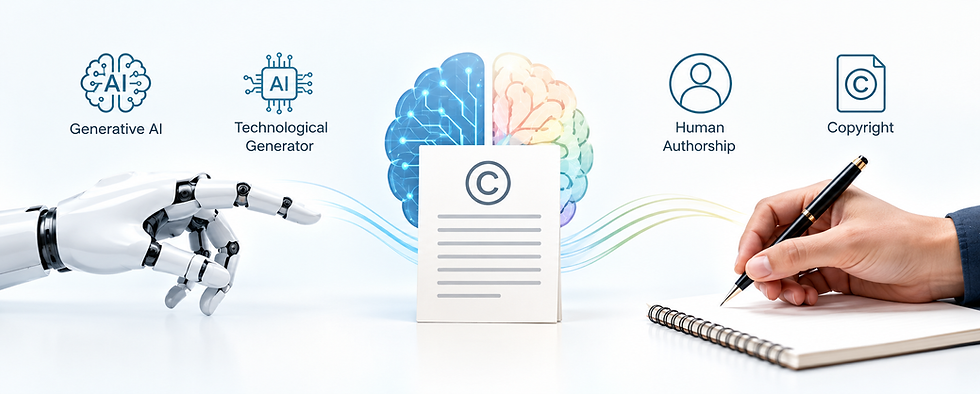
An AI cannot be an author under the current law. Copyright is only issued to human authors for their original work, someone who uses human intelligence to create ideas and inventions can only be termed as an author. On the other hand, when we take a look at AI it’s a machine not a legal person, cannot own property or rights. However, unlike the traditional tool the developing AI generated contents are a replica of human talent here the question arises whether the AI can be given an authorship?
The US court clearly said that copyright is imposed on original works of human authorship, any AI generated content without human intervention will not be given copyright protection nor can an AI be declared as an author.
Deep Fakes and its emerging legal concerns
The rapidly emerging AI generated contents gave rise to deep fakes. Deep fakes are highly realistic content of humans in the form of audio, video, or image. Deep fakes use AI algorithms, particularly deep learning and neural networks, to manipulate a person’s likeness including their face, voice, or expressions and place them into situations that never actually occurred. If deep fake is designed to imitate realistic content of humans. Is the law providing protection for the real content or an imitated content? Or does providing copyright to such content valid?
Copyright Issues
A key concern associated with deep fakes pertains to copyright legislation. Often deep fakes content is made using the existing copyrighted works without prior permission that constitute a violation of copyright
So, I was thinking, is it really fair to give fake content the same kind of protection as something that is real? Should a deep fake get copyright protection? The thing is, a deep fake is not really a creative or original work it is something that is made to look like something else so should deep fake be treated like an original work and get copyright protection or is that not right?
Economic Problem
AI can supply multiple contents in a single sitting that can boost the supply market and if given copyright protection it will lower the opportunity and income for human creators. This might discourage the human creators in the long run and the emerging AI might take over the opportunities that once were for humans. At the same time AI-generated content does not have a human author which leads to the confusion of who is the author and whether the work should be protected? Due to such complex and confusing circumstances there is a need for a new or revised legal framework clearly defining the ownership, responsibility and the difference between human and AI creation. Without proper rule it causes a disturbance in supply demand balance in the economy. If thousands of AI-generated work receives copyright the market would be flooded with AI generated content .In such scenarios what happens to the real talent and human creators, will AI take over the human talent, is the law giving protection and authorship to AI generated contents?
Conclusion
The Indian Copyright Act of 1957 specifically mentions that AI generated contents cannot be copyrighted neither the AI can have authorship, nevertheless it doesn’t specifically mention that only humans can be creators but the judicial interpretation clearly indicates that copyright is issued to humans and not machine or AI. Thus, the authorship of an AI is an ongoing debate topic in the tech landscape, which is yet to be concluded.
With the rapidly growing Artificial intelligence and AI generated work the traditional understanding is being challenged and creates complexity and legal confusion among the emerging technology.
Therefore, a balanced and well-defined legal framework is needed to address the rising issues related to artificial intelligence.
Author: Varsha Divyeshan, in case of any queries please contact/write back to us via email to chhavi@khuranaandkhurana.com or at Khurana & Khurana, Advocates and IP Attorney.
References
Copyright -what everyone needs to know -Authored by Netanel, Neil Weinstock.
Artificial intelligence and copyright: issues and challenges by VK AHUJA
Eastern Book Company vs DB Modak (2008) 1 SCC 1; AIR 2008 SC 809; 2008 (36) PTC 1 (SC)

Comments